Guides & expertise · Diamantaires OG
Sell a SCAN or CIBJO diamond
Come with or without an appointment
43 RUE BEAUBOURG 75003 PARIS
Rambuteau Metro
Your diamond can be analyzed by recognized gemological laboratories, which will issue a certificate attesting to its characteristics and therefore its value. While the SCAN and CIBJO grading systems used for antique diamonds are no longer current, diamond grading has been standardized, and today there are a few grading scales, notably those of the GIA and EGL. We explain the differences between the old grading systems and the newer ones, which you should use if you wish to have your diamond analyzed.
The 4Cs: The Foundation of the Current Diamond Grading System
The GIA (Gemological Institute of America), an American gemological laboratory founded in 1931, originated an international diamond quality evaluation system known as the "4Cs." Four aspects of the diamond are analyzed: weight (Carat), clarity (Clarity), color (Color), and cut (Cut). The value of the diamond is estimated based on these four parameters.

Diamond Color
Diamond color can vary: the more colorless and transparent they are, the more valuable they are. The grade assigned to a diamond for its color varies by gemological laboratory.
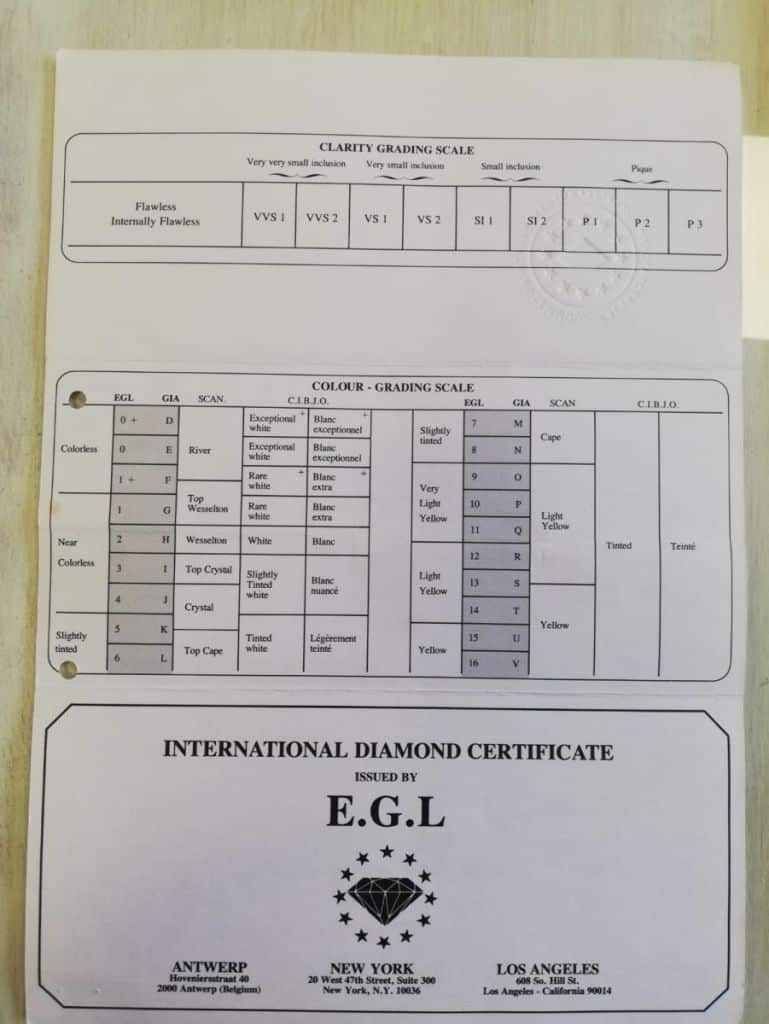
SCAN was based on a scale comprising the following levels, from most colorless to most yellow: River, Top Wesselton, Wesselton, Top Crystal, Crystal, Top Cape, Cape, Light Yellow, Yellow.
CIBJO was based on the following more descriptive scale: Exceptional White +, Exceptional White, Extra White +, Extra White, White, Slightly Tinted, Tinted White, Colored.
Nowadays, we primarily rely on the GIA or EGL notation system. The GIA assigns letters to qualify diamond color, from D to Z (allowing for finer analysis); while the EGL assigns numbers, from 0+ to 16. As follows:
- "Colorless" corresponds to D, E, F or 0+, 1, 1+
- "Near Colorless" corresponds to G-J or 1-4
- "Faint Yellow" corresponds to K-N or 5-8
- "Very Light Yellow" corresponds to O-Q or 9-11
- "Light Yellow" corresponds to R-T or 12-14
- "Light Yellow" corresponds to U-Z or 15-16.
- "Yellow" corresponds to Z+
The advantage of these notations is the uniformity of analyses. Whereas in the past, a diamond could be "Crystal" for SCAN and "Slightly Tinted" or "Tinted White" for CIBJO; today, a diamond graded J by the GIA will always be equivalent to a grade 4 diamond from the EGL, i.e., "Near Colorless."
Diamond Clarity
Diamond clarity measures the impurities a diamond contains, i.e., inclusions (small crystals within the diamond), blemishes, or traces. To determine a diamond's impurities, gemologists observe it under a microscope (10x magnification). Like a fingerprint, a diamond's inclusions, their number, and arrangement make it unique. The more inclusions a diamond contains, the lower its value.
Today, we use the following scale to determine diamond clarity, from purest to least pure:
- F (Flawless): These diamonds contain no inclusions and no internal or external defects. They are very rare.
- IF (Internally Flawless): These diamonds contain no internal inclusions.
- VVS1 and VVS2 (Very Very Slightly Included): These diamonds contain inclusions that are very difficult to see under a loupe. Level 1 or 2 is assigned based on the number of inclusions, with VVS2 corresponding to the less pure diamond.
- VS1 and VS2 (Very Slightly Included): These diamonds contain inclusions that are difficult to see under a loupe but still invisible to the naked eye.
- SI1, SI2, and SI3 (Slightly Included): These diamonds contain small inclusions that are easy to see under a loupe but generally invisible to the naked eye.
- I1, I2, and I3 (Included) or in French, P1, P2, and P3 (Piqué): Inclusions are visible under a loupe and to the naked eye (more or less easily depending on level 1, 2, or 3).
Diamond Weight and Cut
The other two main parameters, weight and cut, are less subjective. Therefore, there is not much difference between the various diamond grading systems. Diamond weight is expressed in carats, with 1 carat = 1/5th of a gram (200 mg). Since diamonds of several carats are rare, the larger the diamond, the higher the price per carat.
As for cut, it is expressed in terms of the diamond's proportions and its play of light. The diamond can be cut in a brilliant, round, or fancy shape (cushion, radiant, heart, oval, princess, marquise, etc.). Polish and symmetry are also taken into account in the analysis of the diamond's cut.
On these two parameters, the different grading systems do not vary.
-> Complete guide on diamond cuts
Selling a Diamond with an Old CIBJO Certificate
Diamantaires OG Paris buys back and appraises your old diamonds with old certificates free of charge. Antique diamonds often require recutting before being reintroduced to the diamond market.
Other Gemological Laboratories Worldwide
You will find in this list the gemological laboratories located in France.
To distinguish a real diamond from a fake or to determine the real value of a diamond, some laboratories produce analysis reports or authenticity certificates. These
European Gemological Laboratory (EGL)
The European Gemological Laboratory (EGL) is one of the few gemological laboratories authorized to issue certification attesting to the value of a diamond, with the
Appraise & Sell your GIA diamonds 01 48 87 81 44 Sell Sell / Appraise a GIA diamond for free Buying a diamond is not always
The French Gemological Laboratory
01 48 87 81 44 Our customer service team is available free of charge for more information on the French Gemological Laboratory. You can
We guarantee the best prices; if you have a direct buyback offer from a competitor, we will not only match it but
What are the SCAN and CIBJO grading systems?The SCAN and CIBJO grading systems were methods used to evaluate antique diamonds. Although no longer in use today, they served to classify diamonds according to criteria such as color and clarity.
What are the current diamond grading systems?Today, diamonds are primarily evaluated according to the GIA (Gemological Institute of America) and EGL (European Gemological Laboratory) systems, which use more detailed and uniform scales for color and clarity.
How is diamond color currently evaluated?Diamond color is evaluated on a scale from D (colorless) to Z (light yellow) for the GIA, and from 0+ to 16 for the EGL. This scale allows for a finer analysis of diamond color.
How is diamond clarity determined?Diamond clarity is evaluated based on the inclusions present, ranging from F (Flawless, without defects) to I3 (Included, with visible inclusions). This evaluation is done under a microscope to determine the diamond's clarity.
Can I have a diamond with an old CIBJO or SCAN certificate appraised at Diamantaire Paris?Yes, Diamantaire Paris offers free appraisal of antique diamonds with old CIBJO or SCAN certificates. They can also help recut the diamond before reintroducing it to the market.
At Diamantaire Paris, we are proud of our expertise in diamond evaluation and certification, particularly thanks to our in-depth knowledge of CIBJO and SCAN standards. These certification systems ensure that every diamond we evaluate meets the strictest international standards, giving you peace of mind and assurance about the quality and value of your precious stone.
If you are looking to sell or buy a diamond or a sapphire, it is crucial to understand its true price. Our guide on the price of 2-carat diamonds offers valuable information to help you navigate the market. Additionally, if you own a piece of jewelry without the necessary paperwork, our service for selling a diamond without a gemological certificate can help you obtain a fair and accurate evaluation.
For those looking to sell designer jewelry, we offer specialized appraisals, such as for JAR designer jewelry. Our expertise in this area ensures that your piece will be evaluated with the utmost care and professionalism.
Finally, if you have jewelry or diamonds to sell, feel free to contact us. Our team of experts is at your disposal to answer all your questions and guide you through the appraisal and sales process. At Diamantaire Paris, we are committed to providing you with a transparent, fair, and high-quality service.
Free, no-obligation estimate
Combien valent vos bijoux ?
In-person appraisal by a state-certified gemologist — firm offer, immediate payment, in complete confidentiality.