Guides & expertise · Diamantaires OG
What is the content of the GIA certificate?

Check and appraise your GIA diamond for free
Founded in 1931, the Gemological Institute of America (GIA) is a leading gemological laboratory, notably known for developing a universal grading system to assess diamonds and precious stones with precision. Created in 1953, the GIA classification system has now become the standard for all diamond dealers. Discover the purpose of the GIA certificate, the grading system it is based on, and its content.
Diamantaire Paris offers an alternative for immediate jewelry buyback without auction.
More information without an appointment at 43 rue Beaubourg 75003 Paris, or by phone: +33 1 48 87 81 44
What is the GIA certificate used for?
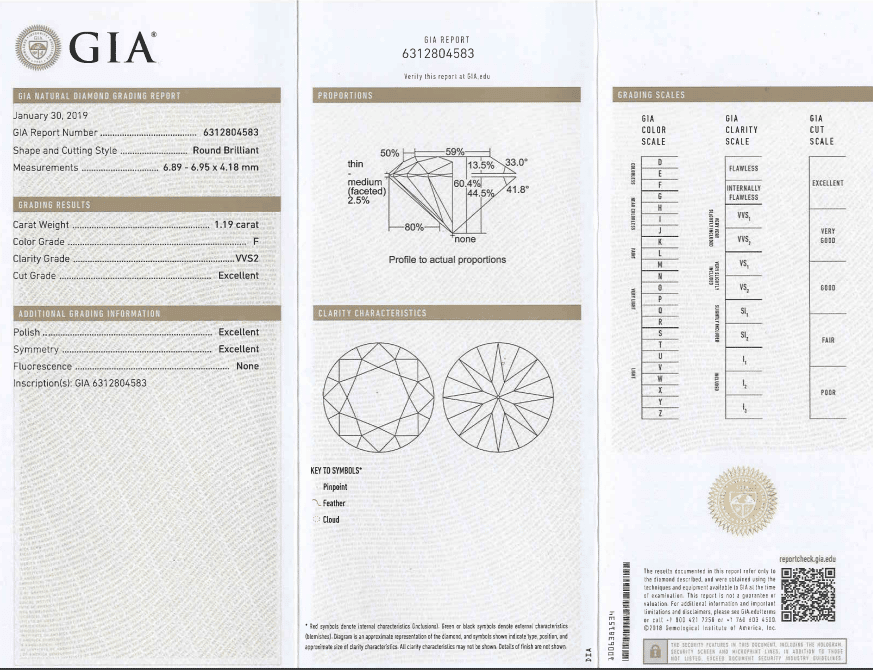
The GIA has the authority to issue certificates that attest to the quality of diamonds or precious stones and detail their characteristics. The GIA certificate is one of the most renowned for authenticating the quality of a diamond, along with the IGI and HRD certificates. It is notably valid with insurance companies.
Once you have your diamond certified by the GIA, they will return it with a laser inscription of the certificate number on the girdle and a paper certificate listing the diamond's characteristics. Each precious stone has a unique identification number, and all GIA certificates are publicly indexed online.
The GIA certificate is also useful when buying or selling a diamond: made with holograms and micro-printing, it cannot be imitated, thus guaranteeing its authenticity.
01 48 87 81 44 Our customer service is available free of charge for more information about our profession as a Diamond Dealer in Paris.The different types of GIA certificates
The GIA issues two types of reports. The Diamond Grading Report is a comprehensive report reserved for diamonds over 0.15 carats with color between D and Z. This report includes the diamond's characteristics and a diagram showing the diamond's relative size and inclusions. The GIA Diamond Dossier, reserved for D-to-Z color diamonds weighing between 0.15 and 1.99 carats, is a more concise version of the GIA certificate that includes the same information but without the diagram.
Need help appraising your GIA diamond? 01 48 87 81 44Come with or without an appointment
43 RUE BEAUBOURG 75003 PARIS
Metro Rambuteau
The GIA diamond grading system
The GIA certificate uses the diamond grading system developed by the GIA in 1953, the International Diamond Grading System. This grading system is based on the 4Cs: Carat weight, Clarity, Color, and Cut. The value of the diamond is mainly estimated based on these four parameters, but also on other characteristics such as polish, symmetry, or fluorescence.
Content of the GIA certificate
Diamond color
Color varies from one diamond to another; the more colorless and transparent the diamond, the more valuable it is. To qualify the color of the diamond, the GIA uses a scale from D to Z (from the most colorless to the most yellow diamond):
- A "Colorless" diamond is graded D, E, or F
- A "Near Colorless" diamond is graded G, H, I, or J
- A "Faint Yellow" diamond is graded K, L, M, or N
- A "Very Light Yellow" diamond is graded O, P, or Q
- A "Light Yellow" diamond is graded R, S, or T
- A "Yellow" diamond is graded U, V, W, X, Y, or Z
- A "Fancy Yellow" diamond is graded Z+.
Diamond clarity
The GIA certificate also evaluates the clarity of the diamond. When analyzing the diamond, gemologists observe it under a 10x magnification microscope and measure its imperfections, namely inclusions (small crystals inside the diamond), traces, and blemishes. Each diamond is unique due to its inclusions (their number and arrangement): the diamond's imperfections essentially constitute its fingerprint. But the more inclusions the diamond contains, the lower its value.
The scale used by the GIA to measure diamond clarity is as follows, from the purest to the least pure diamond:
- F (Flawless) means the diamond contains no inclusions (F diamonds are very rare!)
- IF (Internally Flawless) means the diamond contains no internal inclusions
- VVS1 and VVS2 (Very Very Slightly Included) means the diamond contains inclusions that are very difficult to see under a loupe. Depending on the number of inclusions, the diamond is assigned level 1 or 2 (VVS2 corresponding to the less pure diamond)
- VS1 and VS2 (Very Slightly Included) means the diamond contains inclusions that are difficult to see under a loupe but still invisible to the naked eye.
- SI1, SI2, and SI3 (Slightly Included) means the diamond contains small inclusions that are easy to see under a loupe but generally invisible to the naked eye.
- I1, I2, and I3 (Included) means the diamond contains inclusions that are visible under a loupe and to the naked eye. Level 1, 2, or 3 determines whether the inclusions are easily visible (I3 corresponding to the least pure diamond).
Diamond weight
The diamond weight in carats is also listed on the GIA certificate. The weight of the diamond is determined by weighing it on a precision carat scale, to at least a tenth of a carat. 1 carat equals 1/5th of a gram, i.e., 200 mg. The value of the diamond is not proportional to the number of carats: the larger the diamond, the higher the price per carat because multi-carat diamonds are rarer.
Diamond cut
The last of the 4Cs on the GIA certificate is the diamond's cut. To determine it, GIA gemologists study the diamond's shape (e.g., round brilliant or a fancy shape like cushion, princess, pear, or oval) as well as how the diamond interacts with light (brightness, scintillation, and fire). The cut quality is then graded on the following scale:
- Excellent
- Very Good
- Good
- Fair
- Poor
Other diamond characteristics
Other characteristics are included on the GIA certificate for greater precision, such as fluorescence, polish, or symmetry. Gemologists thus analyze the quality of the diamond's polish and symmetry and also grade them on a scale from Excellent to Poor.
For fluorescence analysis, they expose the diamond to ultraviolet light. A fluorescent diamond will take on a blue tint. Based on the observed fluorescence, they can characterize it on the following scale:
- None: no fluorescence
- Very Slight: very little fluorescence
- Slight or Faint: little fluorescence
- Medium: medium fluorescence
- Strong: strong fluorescence
- Very Strong: very strong fluorescence.
The diagram
For diamonds over 0.15 carats, the Diamond Grading Report includes a diagram representing the diamond's inclusions and its proportions. If you have opted for the GIA Diamond Dossier, available only for diamonds weighing between 0.15 and 1.99 carats, then the diagram is not included.
The certificate number
Each diamond is assigned a unique number, the GIA certification number. At the end of the diamond analysis, GIA gemologists laser-engrave this GIA certificate number on the diamond's girdle. It is important because it guarantees the diamond's certification and its identification for diamond dealers.
Appraise a diamond What is the GIA certificate and what is it used for?The GIA certificate, issued by the Gemological Institute of America, attests to the quality of diamonds or precious stones and details their characteristics. It is recognized for its authenticity and is useful for buying, selling, and insuring diamonds.
What are the different types of GIA certificates?The GIA issues two types of reports: the Diamond Grading Report for diamonds over 0.15 carats and the GIA Diamond Dossier for diamonds from 0.15 to 1.99 carats. The former is a comprehensive report with an inclusion diagram, while the latter is a more concise version without a diagram.
What is the GIA diamond grading system based on?The GIA grading system is based on the 4Cs: Carat weight, Clarity, Color, and Cut. These criteria, along with other characteristics like polish, symmetry, or fluorescence, determine the value of the diamond.
What information is found on a GIA certificate?The GIA certificate includes details on color, clarity, weight, and cut of the diamond, as well as other characteristics like fluorescence, polish, and symmetry. Each diamond has a unique laser-engraved identification number.
How does Diamantaire Paris use GIA certificates?Diamantaire Paris stands out for its expertise in evaluating and certifying diamonds according to the rigorous GIA standards. They offer appraisal and immediate jewelry buyback services, as well as advice on purchasing GIA-certified diamonds.
Diamantaire Paris stands out for its expertise and commitment to excellence, particularly when it comes to evaluating and certifying diamonds. Our use of the rigorous GIA standards ensures our clients receive an accurate and reliable evaluation, as evidenced by the content of the GIA certificate. We understand the importance of every detail in the evaluation process, whether it be clarity, illustrated in our diamond clarity guide via the 4Cs rule, or market value, explained in our diamond price guide.
Our expertise is not limited to diamond evaluation. We also offer specialized services for those looking to sell Art Deco jewelry or invest in high-end pieces, as evidenced by our collection of Van Cleef & Arpels jewelry. For those looking to sell or appraise specific designer jewelry, we offer evaluation services for brands such as Boucheron and Cartier.
At Diamantaire Paris, we are committed to offering a transparent and trustworthy service. Whether you are looking to sell a bracelet, invest in a GIA diamond, or understand how to obtain a diamond's weight, we are here to guide you every step of the way. Visit our jewelry store in Paris or contact us to discover how our expertise can help you achieve your high jewelry aspirations.
In the same section
Free, no-obligation estimate
Combien valent vos bijoux ?
In-person appraisal by a state-certified gemologist — firm offer, immediate payment, in complete confidentiality.